
Surrogacy

HOTLINE
1-888-492-6688
6266881159
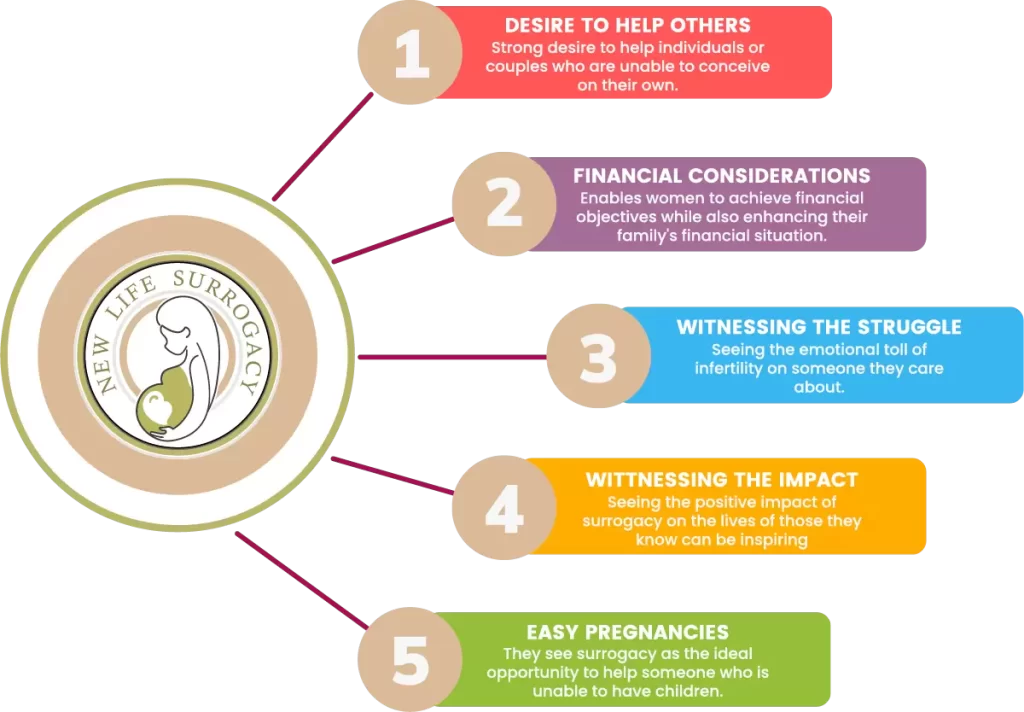
Why Do Women Become Surrogates ?
Women become surrogates for various reasons, including a desire to help others facing infertility, empathy, and compassion. Some enjoy the experience of pregnancy and see surrogacy as a way to share that joy.
Financial compensation, previous positive surrogacy experiences, educational fulfillment, and having a strong support system can also be motivating factors. Each woman’s motivation is unique, but a common thread is the desire to contribute to building families for those who face challenges in conceiving.

Who Do Surrogates Help?
Surrogates primarily help individuals or couples facing infertility or reproductive challenges. These intended parents may be unable to conceive and carry a pregnancy to term for various reasons, such as medical issues, same-sex couples, or individuals without a uterus. By becoming surrogates, women provide a valuable and selfless service, assisting intended parents in realizing their dream of having a biological child. The help provided by surrogates extends beyond the physical act of carrying a pregnancy, often making a profound and positive impact on the lives of those struggling to build their families.

New Life Surrogacy:“Where Dreams Begin and Families Grow”
5 Things You Need to Know About Surrogacy
They have no biological relationship
The surrogate mother has no biological relationship with the baby. Their DNA and eggs will not be used to cultivate the embryo.
Payment can be made during surrogacy.
The surrogate mother will be paid throughout the entire surrogacy process, even starting before the pregnancy.
Your prospective parents have a say.
The surrogate mother can choose with whom to pair up. All pairings are based on the mutual consent of both parties.
Having no attachment to infants
The surrogate mother does not develop an “attachment” to the baby she is carrying. What she anticipates is the moment when the designated parents can hold their own child for the first time.
Requires self-injection
Lorem ipsum dolor sit amet, consectetur adipiscing elit, sed do eiusmod tempor incididunt ut labore et dolore magna aliqua.
SURROGATE PROCESS

Pre-screening
Fill out the application form and make the initial contact
Arrange a video interview and complete the application form
Conduct the video interview
Sign the documents
Medical Record
Obtain medical records
Institution reviews medical records
Matching
Create a personal profile and share it with the intended parents
Share the personal profile of the intended parents with the surrogate mother
Conduct a matching interview with the intended parents
Formal matching
Share the records with potential intended parents and the IVF clinic
Drugs and Transportation
Start medication (usually by injection)
Simulation period (if required by the IVF clinic)
Embryo transfer (the second and final one, the surrogate mother must travel)
Monitoring and Heartbeat Confirmation
Local monitoring
Confirmation of fetal heartbeat –
Graduated from the IVF clinic
Transferred to the obstetrics and gynecology department
From pregnancy to postpartum
Obstetrics and Gynecology Appointment
Delivery
Postpartum Follow-up
© 2026 New Life Surrogacy. Created for free using WordPress and Kubio